Building DTC Commerce for Games: Architecture, Integrations, and the MoR Layer
Think of Direct-To-Consumer (DTC) as a Monetization Bridge
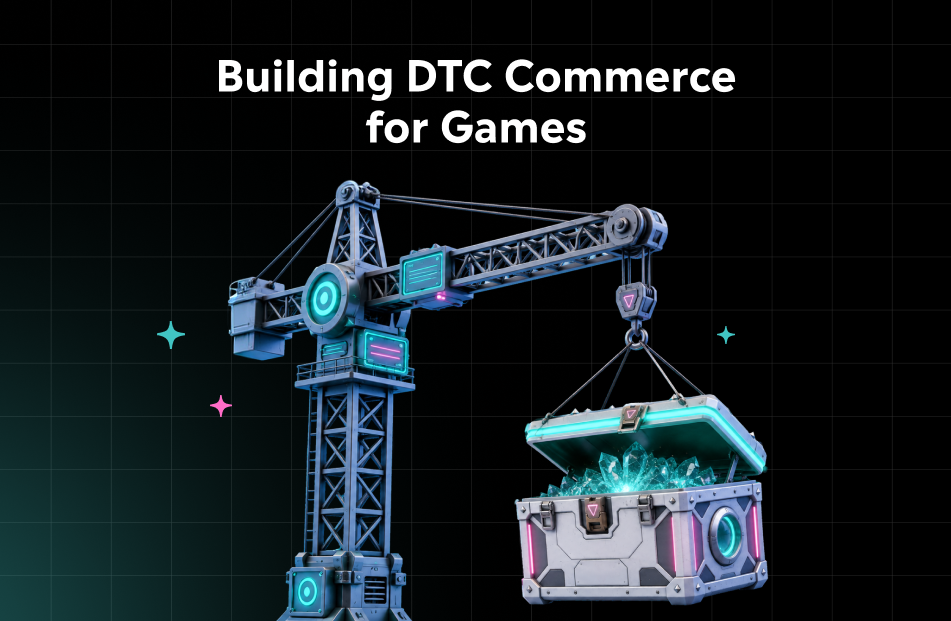
DTC monetization isn’t “add a checkout page.” It’s an architectural pivot. You’re moving from platform-store guarantees (Apple, Steam) to your own. Your entitlement truth. Your fraud surface. Your reconciliation.
Think of DTC as a Monetization Bridge: it connects your game’s internal economy to the global financial system. Bridges fail in predictable ways-bad load paths, missing joints, no redundancy.
If you don’t design the joints (APIs, webhooks, idempotency), you’ll ship money into the void and hand out items you can’t claw back.
The Full Scope of the MoR Layer
Before diving into the technical plumbing of item delivery, it is crucial to understand what a Merchant of Record (MoR) actually takes off your plate. An MoR is not just a payment gateway or an API wrapper. It is the legal entity that handles the entire financial lifecycle of a transaction:
- Global Tax Compliance: Automatically calculating, collecting, and remitting VAT, GST, and sales tax across 100+ countries.
- Fraud & Chargeback Liability: Absorbing the financial and legal risks of friendly fraud and dispute management.
- Merchant Infrastructure: Managing localized payment methods, currency conversion, and global banking relationships.
This is where Tebex sits. As a specialized MoR, we handle all of this legal and financial machinery outside your game. However, that doesn't eliminate the engineering work - it relocates it to the place you must always retain absolute control over: your backend and your game data.
The Threat: "Paid" Isn’t "Granted"
Platform stores hide the hard parts, then they take 30%. When you go DTC, you gain margin and data, but you inherit a new failure mode: state drift.
The player paid. Your backend didn’t grant. Or worse: you granted, a chargeback hits, and you never revoked. The only safe mental model is this: Money moves in one system; entitlements live in another. Your job is to keep them consistent under stress. That is the bridge.
Stop Building What You Can Buy
Before you over-engineer a custom solution, look at your environment. If you’re building within Roblox, Fortnite (UEFN), or core Unreal Engine ecosystems, stop coding.
Tebex’s battle-tested plugins are the "easy button" that actually works. We handle the heavy plumbing of integration so your engineers can focus on gameplay, not payment logs. It’s not laziness; it’s resource allocation. Use the plugins for the standard infrastructure; use the API only for your proprietary logic.
The Minimal DTC Spine: Create -> Verify -> Grant
Don’t overthink the core loop. Fortify it.
1. Create Order
Your backend initiates a purchase with Tebex. You generate an internal order record: order_id, player_id, and the expected payload. This is your future audit trail.
2. Verify Receipt (Don’t Trust the Client)
Clients lie. Networks collapse. Retries happen. Verification happens via Tebex webhooks or API status checks. The rule is absolute: No grant without verification. No verification without idempotency.
3. Grant Entitlement
Granting is a write to your authoritative game economy. Make it transactional: Write the entitlement, apply the grant, and mark the order as FULFILLED. If any step fails, you retry safely.
The Plumbing: Idempotency and Webhooks
Every "create," "verify," and "grant" operation must be idempotent. Assume webhooks will arrive twice, your workers will restart mid-flight, and the player will spam refresh. An idempotency key (order_id + action_type) is your crash helmet. Don’t "try your best." Be deterministic.
Webhooks are your synchronization lifeline-and your attack surface. Verify every signature. Enqueue quickly, process asynchronously, and log the raw payload for replay. Webhooks aren’t a "nice to have"; they are how you keep the bridge from swaying in the wind.
Integration Patterns: Pick Your Failure Mode
- The Proxy: A thin server where your backend proxies calls to Tebex. Fast to ship, but you'll pay in latency and tight coupling.
- The BFF (Backend for Frontend): A purpose-built API layer for your store. Cleaner contracts, but more surface area to secure.
- Event-Driven Sync: This is the gold standard. Payments and changes flow through events (webhooks -> queues). It scales cleanly and absorbs retries, providing the best balance between latency and consistency.
Tebex vs. The DIY Hell
Stripe gives you primitives. Tebex gives you a bridge. With a standard PSP, you are signing up for a long tail of operational misery: tax remittance in 100+ countries, cross-border compliance, and the legal burden of being the "Seller of Record."
Because Tebex is the MoR, we don't just process the payment-we own the tax trail. You get a single, clean payout. That’s margin you can actually defend.
Disputes: Lock the Gate
Chargebacks aren’t a hypothesis; they’re a cost of doing business. But in a DTC model, a dispute isn't just a lost sale-it's a security breach.
This is where the MoR model pays for itself. Tebex handles the legal and financial representment at the bank level, but we also trigger the perimeter defense: the moment a dispute is raised, the bad actor is flagged and locked out of the storefront. Your only job? Ensure your backend listens to that signal. If you aren't automating the revocation of entitlements in-game the second a payment is reversed, you aren't running a store-you're running a charity for fraudsters.
The Logic: Build, Then Stress
DTC monetization is backend engineering with money attached. Build around the Create -> Verify -> Grant loop. Wrap it in idempotency. Drive it with webhooks. Police it with scheduled reconciliation.
The bridge is either engineered-or it’s a future incident report.
FAQ
What is the best integration pattern for high-scale games?
Event-driven architecture (webhooks + queues) is the most resilient. It handles volume spikes and ensures the game state eventually converges with the payment state without blocking the player.
How does Tebex handle global taxes?
As the Merchant of Record, Tebex calculates, collects, and remits VAT/GST globally. The studio is shielded from the legal complexity of international tax law.